The Last Speaker
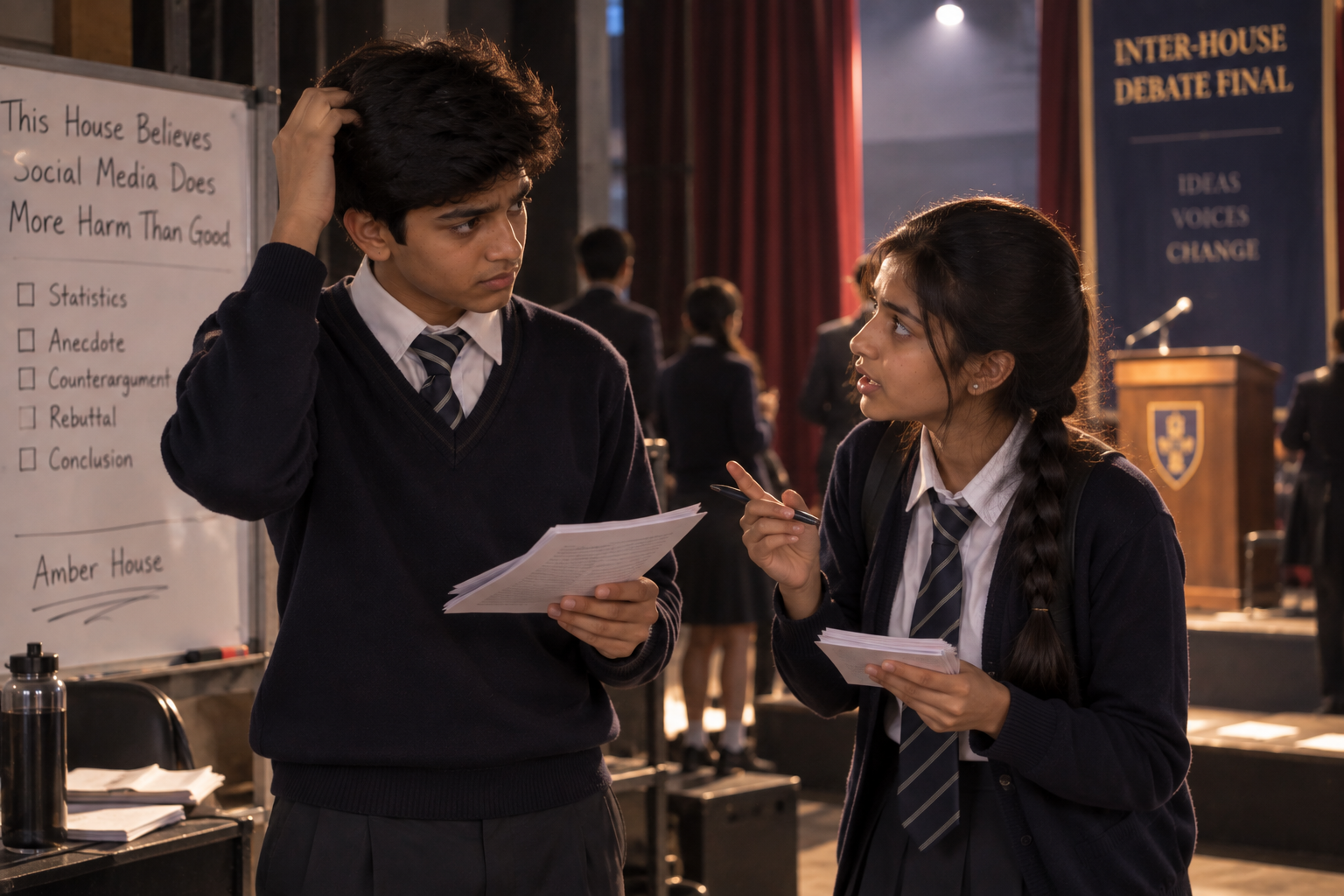
The inter-house debate final was scheduled for four o’clock, and by half past three, Meera had already reorganized the index cards on the green room table three times.
It wasn’t that they were in the wrong order. It was that reorganizing them gave her hands something to do other than shake.
As captain of Amber House, she had spent six weeks building this team the way she built everything, carefully, methodically, with a spreadsheet nobody else had asked for. She’d drafted the arguments herself, timed every rebuttal to the second, and rehearsed the team twice a week in the empty chemistry lab because it was the only room with decent acoustics. Amber House hadn’t won the debate final in four years. Meera intended for that number to stop today, and she intended to be the reason.
Which was why, at twenty to four, when Yash, their first speaker, their strongest speaker, the one whose closing arguments could make a teacher’s union sound reasonable, texted to say he’d been throwing up since lunch and wasn’t coming, Meera felt something in her chest fold in on itself like a paper crane crushed in a fist.
“Okay,” she said out loud, to no one, because saying it out loud was the only way she knew how to keep her voice from doing anything unhelpful. “Okay. Okay.”
She looked around the green room. Two remaining debaters were flipping through notes, pale with their own nerves, in no state to absorb a whole extra role. The topic, This House Believes Social Media Does More Harm Than Good, sat scrawled on the whiteboard, mocking her with its neutrality.
Her eyes landed on Aarav.
He was sitting on the windowsill, not part of the debate team at all, technically present only because he’d been roped into carrying the trophy case up from the sports room and had stayed to watch out of boredom. He was balancing a pen on his knuckle, entirely unbothered by the small catastrophe unfolding six feet away from him.
“You’re funny,” Meera said.
Aarav looked up. “Thank you? I think?”
“You’re quick. You think on your feet. You always have something to say.”
“Meera, what is happening right now.”
“Yash’s out sick. We need a first speaker in twenty minutes.”
Aarav’s pen stopped mid-balance and clattered to the floor. “No.”
“You’re the only person in this room who can improvise an argument without a script.”
“I improvise jokes, not, whatever this is. Rebuttals. Arguments. Things with structure.”
“It’s the same skill.”
“It is extremely not the same skill.”
But Meera was already pulling him off the windowsill by the sleeve, and Aarav, who had never in his life successfully said no to a girl looking at him like the ceiling was about to fall in, found himself being handed a stack of index cards fifteen minutes before walking onto a stage in front of the entire senior school.
The auditorium was fuller than either of them had expected. Four hundred students, a panel of three judges at a table draped in the school’s crimson cloth, and a moderator adjusting a microphone that shrieked once before settling.
Backstage, in the wings, Meera ran through the opening argument with him one final time, her voice low and fast.
“You open with the statistic. Sixty-four percent of teenagers report,”
“I’ve got it.”
“Then you pivot to the anecdote about,”
“Meera.”
“What?”
“I’ve got it. Stop looking at me like that.”
“Like what?”
“Like you’re checking whether I’m going to drop the plate.”
She stopped. It was, uncomfortably, exactly what she’d been doing.
“Sorry,” she said.
“It’s fine.” He didn’t sound like it was fine. His hands, she noticed, were doing something small and repetitive against the edge of the index cards, a nervous shuffle he probably didn’t know he was doing.
“Aarav.”
“Hm.”
“You’re going to be okay.”
“I know,” he said, in the exact tone he used when he absolutely did not know.
His name was called. He walked out from the wings into a wash of stage light so bright it flattened the audience into a single dark shape, and for the first time in longer than he could remember, Aarav discovered that his usual trick, reading a room and instantly becoming whatever it needed him to be, didn’t work on four hundred faces he couldn’t individually see.
He opened his mouth. The statistic came out fine. The anecdote came out fine. And then, halfway through the second point, someone in the third row laughed at something unrelated to him, a private joke, a phone lighting up, nothing to do with Aarav at all, and his brain, trained over years to treat any laughter within earshot as data requiring an immediate response, seized the opportunity the way it always did.
He made a joke.
It wasn’t planned. It wasn’t even particularly good, a throwaway line about the moderator’s microphone, delivered with the easy confidence of someone who’d gotten laughs out of far less for years. A ripple of amusement moved through the crowd.
And it felt, for one full second, wonderful. Familiar. Safe.
Then he saw the judges’ faces.
Not amused. Not annoyed, even. Simply, recalibrating. Filing him, visibly, under a different category than the one Amber House needed him in. The debate wasn’t a comedy slot. Nobody had asked to be charmed. They’d asked to be persuaded, and Aarav, for the first time in his life, had reached for his best tool and watched it fail to open the lock.
He finished the argument. He even finished it competently. But when he walked backstage, his hands weren’t shaking from nerves anymore. They were shaking from something worse, the particular shame of having performed the wrong self on purpose, in public, and having it not land.
Meera was waiting in the wings, arms crossed, jaw tight.
“What was that?”
“A joke.”
“I noticed.”
“It usually works.”
“This isn’t ‘usually,’ Aarav, this is a final.” Her voice cracked slightly on the word, not with anger exactly, but with something closer to panic dressed up as anger, which was a costume she wore often and well. “Judges are literally scoring us on persuasive tone. You just spent four points of our credibility on a microphone joke.”
“I know.”
“Then why?”
“Because it’s the only thing I know how to do when I’m scared, okay?” It came out louder than he meant it to, loud enough that the second speaker glanced over from where she was pacing her own nerves into the floor. Aarav dropped his voice, but not the intensity. “You put me out there with fifteen minutes of prep and four hundred people staring at me, and the second something went slightly wrong, I did what I always do. I made it funny so it couldn’t be scary anymore. I didn’t decide to. It just happens.”
Meera opened her mouth to say something sharp, and then didn’t. She was looking at him properly now, the way you look at a familiar object when someone finally points out what it actually is.
“I know that feeling,” she said instead, quieter.
“What?”
“Doing the thing you always do because it’s the only thing that feels like solid ground.” She looked down at the index cards still crushed in her own fist. “I built this entire six weeks so I wouldn’t have to feel out of control for even one afternoon. I have a spreadsheet, Aarav. For a school debate. I timed everyone’s pauses.” A short, unamused laugh. “And the second Yash got sick, I didn’t grieve for one second that a person I actually like was throwing up at home. I panicked about the schedule.”
Aarav looked at her properly too.
“That’s not the same as what I did.”
“It’s exactly the same as what you did,” she said. “You perform confidence so no one sees you’re scared. I perform control so no one sees I’m scared. We’re just doing it in different costumes.”
Somewhere beyond the curtain, the moderator was introducing the second speaker for the opposing house. They had, at most, six minutes before Amber’s second speaker had to walk out and defend a case that had just lost some of its footing.
“Okay,” Meera said, exhaling, and for the first time all afternoon, it sounded less like a command to the room and more like a decision she was making about herself. “New plan. When you close, because you are closing, there’s no one else, don’t try to be the guy who’s good under pressure. Be the guy who’s honest about being under pressure. Judges don’t dock points for a speaker who says this matters to me like they mean it. They dock points for a speaker who’s clearly performing something.”
“That’s terrifying advice.”
“I know.”
“I don’t know how to do that.”
“Neither do I,” Meera admitted. “But I think today might be the day we both have to find out.”
When Aarav walked out for the closing rebuttal twenty minutes later, he did not open with a joke. He opened with the truth, which was nearly as frightening: that he’d walked onto this stage forty minutes ago as a favour, unprepared, that the opening statistic had been the only thing standing between him and a full-blown collapse, and that somewhere in the last half hour he’d realised the topic wasn’t abstract to him at all, that he could point to the exact hour, on the exact evening, when a phone notification had made him feel smaller than he’d felt all year.
It wasn’t polished. It wasn’t the argument on the index card. But the room, which had laughed at the microphone joke and moved on without him, went very still for this instead.
He didn’t win them the debate outright. Amber House lost by four points, a margin so narrow the moderator read it twice to be sure. But when the scores came back, the judges’ written feedback on Aarav’s closing singled it out by name: authentic, unexpectedly moving, argued with real conviction.
Backstage, Meera found him sitting exactly where he’d started the afternoon, on the windowsill, pen back in his hand, though this time it wasn’t balanced on his knuckle so much as gripped.
“We lost,” he said.
“We lost by four points with a first speaker who had fifteen minutes’ notice.” She sat down beside him. “I’ve lost by more with six weeks and a spreadsheet.”
He laughed, a real one, not the reflexive kind. “Are you going to retire the spreadsheet?”
“Absolutely not. But maybe I’ll admit out loud next time that I’m building it because I’m scared, not because it’s efficient.”
“Progress.”
“Small increments,” she said. “That’s apparently what we do now.”
Outside, the auditorium was emptying, four hundred students filing out into the late afternoon, already forgetting the score, the topic, the whole event. But for the two of them, sitting on a windowsill in an emptying green room, something had shifted that had nothing to do with the scoreboard, the quiet, ordinary realisation that the selves they performed to feel safe were not, in fact, the only selves capable of holding a room’s attention. Sometimes the version that trembled a little, and said so, held it better.