The Overflow Table
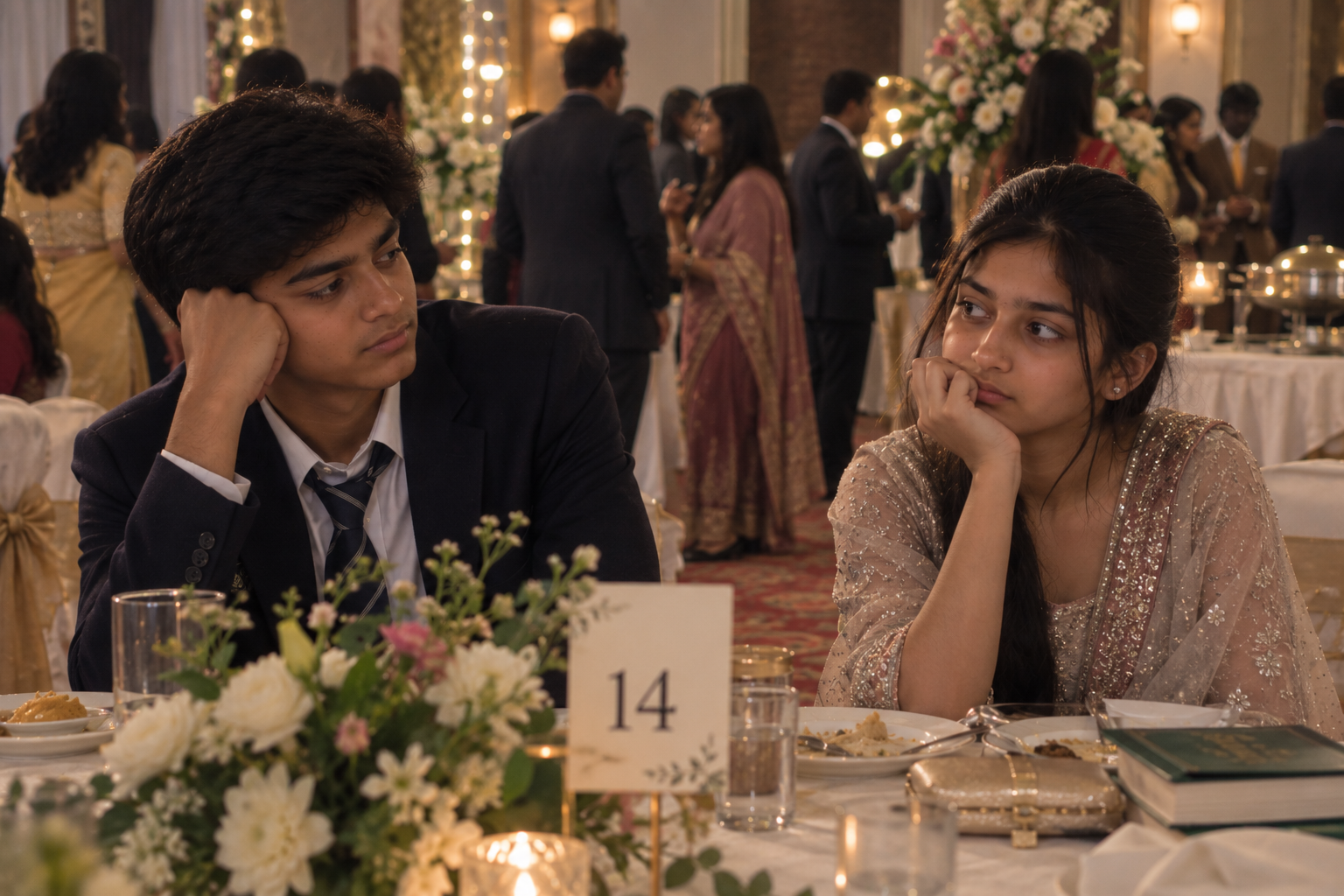
The wedding invitation had said six o'clock, which meant, as every guest over the age of twelve understood without needing to be told, that nothing of consequence would happen before eight.
Meera had been seated at Table 14 for forty minutes before she understood what Table 14 actually was. It sat at the far edge of the banquet hall, half in shadow from a pillar wrapped in marigold garlands, close enough to the buffet to smell the food and far enough from the stage to miss most of what happened on it. It was, she realized as she watched a stream of teenagers drift toward it and then quietly away again, the overflow table: too old for the children's section with its crayons and juice boxes, too young for the tables of aunts and uncles trading stories about people neither she nor anyone else at Table 14 had ever met.
She knew almost no one at the wedding. Her mother had gone to college with the bride's mother, a friendship maintained now mostly through forwarded messages and the occasional phone call, and the connection had been enough to earn Meera's family a spot on the guest list and Meera herself a spot at a table full of strangers with whom she shared, at best, a single degree of separation.
She had brought a book, tucked into her clutch with the optimism of someone who has clearly never attended enough weddings. It stayed in the bag. Instead, she sat very straight in her chair, made polite conversation with two cousins-of-the-groom who left after fifteen minutes to find better company, and did the mental arithmetic that had become second nature over the last few months: how many more hours until dinner, how many more relatives she'd have to field before then, how many times she would be asked, in the next four hours, what she was planning to study.
She had already answered that question twice. Both times, an aunt she didn't recognize had followed up with a comparison to someone else's daughter, delivered in the particular tone reserved for compliments that weren't. Your Sonal didi got ninety-four percent, no? Very good, very good. You'll also do like that, I'm sure. Meera had smiled the smile she kept for exactly this purpose, said something appropriately modest, and felt the now-familiar tightening behind her ribs that she had learned not to let show on her face.
She was midway through composing her third identical smile when someone pulled out the chair across from her.
"Table 14," Aarav said, dropping into the seat with the particular relief of a person who has been standing and performing for longer than he'd planned to. "The island of misfit cousins."
Meera looked up, and it took her a second to place him. Same school, a batch above, someone she recognized from the corridor outside the senior physics lab more than from any actual conversation. "You're from Vidyalaya, right? Aarav?"
"Guilty." He glanced around the table, empty now except for the two of them, the marigolds shedding a slow, quiet rain of orange petals onto the white tablecloth. "How are we related to this wedding, exactly?"
"My mother knows the bride's mother. From college."
"Ah. So you're here on secondhand credentials, same as me. My dad worked with the groom's uncle, briefly, in the nineties. I've never met the groom. I don't think I could pick him out of a lineup."
Meera laughed, surprising herself slightly. "I could. He's the one in the sherwani."
"Very helpful. Thank you."
He reached for the small bowl of roasted namkeen in the center of the table, ate a handful without much interest, and let out a breath that seemed to carry more weight than the joke preceding it. Meera noticed it, the way you notice a single flat note in an otherwise cheerful song, and said nothing, because it wasn't the kind of thing you commented on to someone you'd exchanged four sentences with.
"You look like you've been performing," she said instead, testing the observation lightly, ready to retreat from it if it landed wrong.
Aarav glanced at her, something flickering behind his eyes before the easy expression resettled. "That obvious?"
"You have the exact posture of someone who's been doing impressions for uncles."
"Worse. I did the Rajesh Khanna one for a group of them for almost twenty minutes. They wanted an encore." He shook his head, a short, rueful laugh escaping. "I don't even know why I know that impression. I think I learned it specifically so uncles would ask me to do it at weddings. It's the most useless skill I own and also, apparently, my entire personality at these things."
"At least you have a skill. I just answer the same three questions on a loop." Meera glanced toward the buffet line, where a fresh wave of relatives had begun to circulate. "What are you studying, what rank did you get, what's the plan after twelfth. I've said 'I haven't fully decided yet' so many times tonight it's starting to sound like a lie even to me."
"Is it a lie?"
The question came without much weight behind it, an idle follow-up more than a challenge, but Meera found herself pausing before answering anyway. "No. I genuinely don't know. But saying that out loud to an aunt feels like admitting I've failed some kind of test I didn't know I was taking."
"Try admitting you don't know what you want to become to a table of uncles who peaked in 1994 selling textiles. Watch the concern in their eyes. It's like you've told them you're dropping out to join a circus."
She laughed again, more freely this time, and for a moment the sound surprised them both, cutting through the low hum of distant conversation and the DJ testing a microphone that would not, by any reasonable estimate, be needed for at least another ninety minutes.
A young girl, seven or eight, in a lehenga clearly two sizes too formal for the amount of running around she intended to do in it, appeared at the edge of the table, drawn by the sound of Aarav's laugh from an earlier round of uncle-impressions.
"Do the funny voice again," she demanded, with the total lack of self-consciousness only available to the very young.
"Which one?"
"The uncle one. The angry one who talks about petrol prices."
Aarav obliged, briefly, a passable impression of a specific kind of relative that made the girl shriek with delight and Meera smile despite herself. But before he'd finished, the girl tilted her head, studying him with an unnerving, uncomplicated directness.
"Why do you always make jokes?" she asked. "Even when nothing's funny?"
It wasn't unkind. It wasn't even particularly curious, the way an adult's version of the same question would have been, layered with implication. It was simply a fact she'd noticed, stated the way children state facts, without any understanding of how much weight it might land with.
Aarav opened his mouth to answer, found nothing immediately available, and closed it again. The girl, uninterested in waiting for a response she hadn't really expected, was already running off toward the dessert counter, her lehenga rustling behind her.
For a moment, neither Meera nor Aarav said anything. The easy rhythm of the last few minutes had shifted slightly, the way a room's temperature shifts when a window opens somewhere unseen.
"She's not wrong," Meera said carefully, watching him.
"No," Aarav admitted. He picked up a piece of namkeen he had no intention of eating, turned it between his fingers instead. "I don't really have an answer for her. I don't think I have one for myself either."
"You don't have to."
"I know. It's just strange, hearing it from someone who's small enough to say it without any agenda behind it. Adults ask why I'm funny like it's a compliment they want me to accept. She asked like it was a question that actually needed answering."
Meera considered this, turning her own glass of nimbu pani slowly on the tablecloth, watching the condensation leave a faint ring. "I get a version of that too. Not the funny thing. The good thing. Everyone assumes I like being good at things, being reliable, having an answer ready. Nobody's ever really asked me if I'm tired of it."
"Are you?"
"Sometimes." She hadn't meant to say it quite so plainly, and there was a small pause after, as though she were checking whether the honesty had cost her anything. It hadn't, not yet. "Tonight, especially. Every conversation feels like an audit. What did you score, what will you become, are you as good as this other girl who apparently exists purely to be compared to me. I used to not mind it as much. Now I just feel tired before the question's even finished."
Aarav was quiet for a moment, watching a waiter navigate the crowd with a tray of soup shooters no one seemed to want. "I think we do the same thing, actually. Just in opposite directions. You keep proving you deserve the space you take up. I keep making sure nobody has a reason to look at me too closely." He said it lightly, but there was no joke folded into it this time, no exit ramp. "It's exhausting, being the fun one at every single family thing. Everyone expects it now. If I sat quietly for one wedding, someone would probably ask if I was unwell."
"Would that be so bad? Sitting quietly, once?"
"I don't actually know. I've never tried it long enough to find out."
Across the hall, the DJ's test finally gave way to an actual announcement: the couple's photographs would begin shortly, and all guests were invited toward the stage for the formal pictures. The low murmur of the room shifted into motion, chairs scraping back, aunties reapplying lipstick, someone's father loudly instructing a group of children to stop running near the flower arrangements.
Meera and Aarav sat for a moment longer at the emptying table, an island briefly forgotten in the general movement toward the stage.
"I should probably go find my parents," Meera said, not moving yet.
"Same." Aarav didn't move either.
For a few seconds, neither of them performed anything, not the reliable daughter, not the funny cousin, just two people at a half-cleared table with marigold petals scattered across the cloth between them, momentarily unwatched in a room built entirely around being watched.
Then, somewhere near the stage, a familiar voice called Meera's name, her mother waving her over for the family photograph, and the moment closed as gently as it had opened. Meera stood, smoothed the front of her kurta out of habit rather than necessity, and looked back at Aarav.
"It was nice," she said, "not being asked anything, for a few minutes."
"Table 14," Aarav said, standing too, already reassembling something easier and more familiar across his face as he did. "Underrated real estate."
They walked toward the stage in the same general direction but not quite together, each rejoining a family that would arrange them, within the next few minutes, into practiced smiles and careful postures for a photograph that would later hang on a wall or live in an album, evidence of a wedding neither of them would remember in much detail a year from now.
But for a few minutes, at an overflow table nobody had wanted to sit at, in the space of a stalled schedule and an unwatched pause between one performance and the next, they had each, briefly, put something down.
Neither of them mentioned it again that evening. There was no reason to. It hadn't been the kind of thing that needed following up, only the kind of thing that needed, once, to be noticed.