What He Doesn't Say
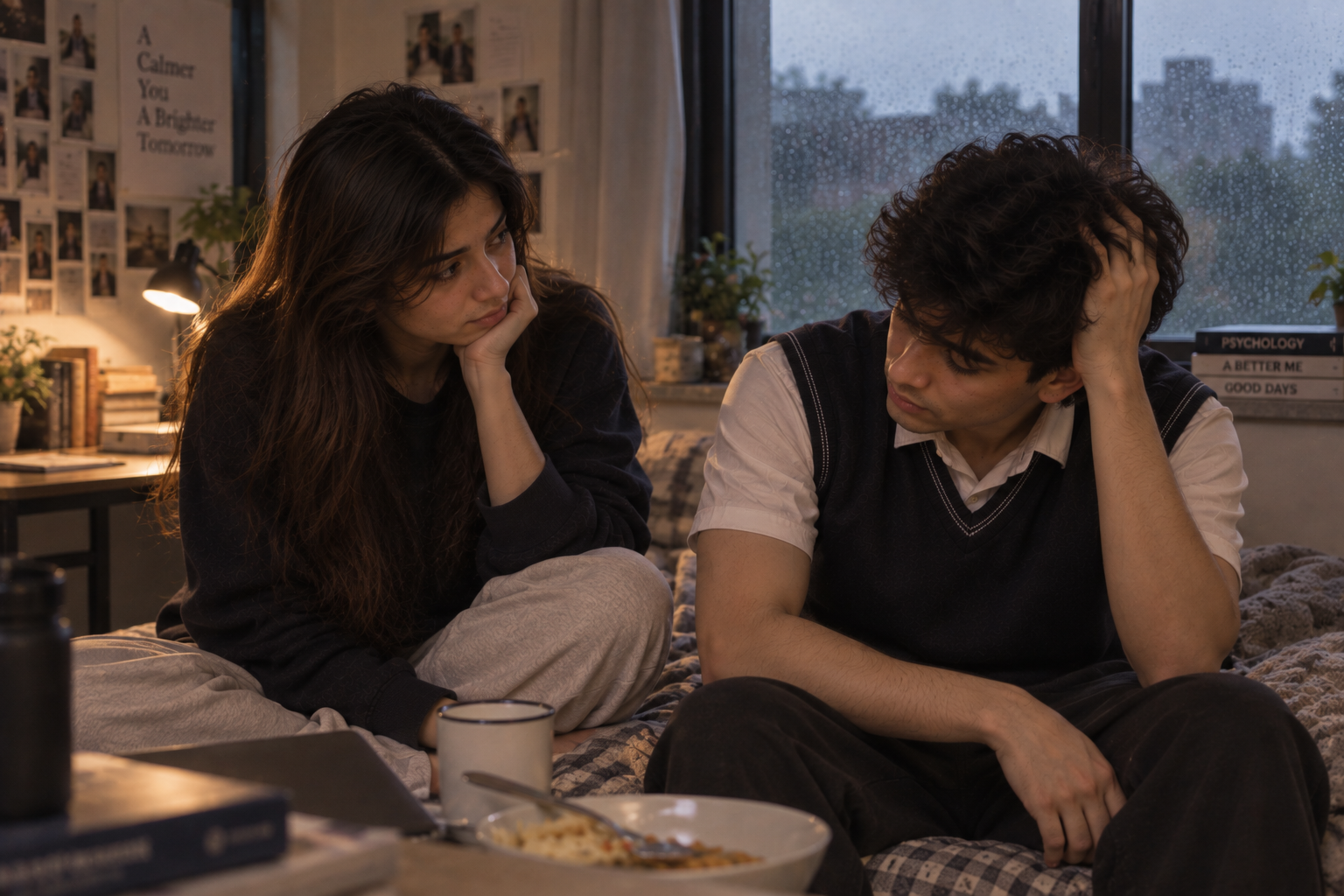
It happened on a Sunday, the kind of gray afternoon that made the whole campus feel slower than usual. Kabir had spent the morning with his roommate again, who was three weeks out from the breakup and still calling him at odd hours, and by the time he reached Aanya's dorm to walk with her to the library, something in his face must have given him away.
"You look tired," she said, opening the door.
"I'm fine."
The words came out automatically, and he heard them the second they left his mouth, heard the exact shape of the thing he always accused other people of doing to themselves. Aanya heard it too. She didn't say anything right away, just studied him the way she used to study a problem set before she learned to look at people the same way.
"That's my line," she said finally. "You don't get to borrow it."
He tried to laugh it off, but it came out thin, the same thinness he'd once diagnosed so easily in her voice weeks ago. "It's nothing. Rohan's still going through it. I just stayed longer than I meant to."
"How long?"
"Since eight this morning."
"Kabir. It's four in the afternoon."
"He needed someone."
"Did you eat?"
He paused, and the pause answered for him.
Aanya stepped back from the door and gestured him inside instead of toward the library. "Sit down. I'm making you something, and you're going to actually eat it instead of telling me you're fine."
He sat on the edge of her bed, unusually quiet, watching her move around her small kitchenette with the same brisk efficiency she brought to everything else. It struck him, watching her, how strange it felt to be on the receiving end of care instead of supplying it. His whole life had trained him to notice what other people needed before they asked. Nobody had trained him to notice, let alone accept, what he needed.
"You've been doing this a lot lately," Aanya said, not looking up from the stove. "Rohan. Before that it was Priya's thesis meltdown. Before that your cousin's family thing. When was the last time somebody showed up for you like this?"
"You're doing it right now."
"I mean before me."
He didn't answer immediately, because the honest answer took him somewhere he didn't like going. "I don't really remember. I think people just assumed I didn't need it. I'm the one who's good at reading what everyone else needs. Nobody thinks to ask if I need anything back."
"Do you ever ask?"
"No."
"Why not?"
He turned the question over, feeling the old defensive instinct rise, the urge to deflect with something light. But the room was quiet and she was still facing the stove, giving him space to answer without the pressure of being watched, and something about that made it easier to be honest.
"Because if I ask and nobody comes, I'll know for certain that I only matter when I'm useful. Right now I can tell myself it's just that I haven't asked. It's safer not to test it."
Aanya turned the burner off and came to sit beside him, close enough that their shoulders nearly touched. "I came," she said simply. "You didn't even ask, and I came."
"That's different. You noticed on your own."
"Maybe that's the whole point. Maybe the people who actually care don't need you to ask. Maybe the asking was never really the test you thought it was."
He looked at her, something loosening in his chest the way it had for her weeks earlier in the study hall, that same specific relief of being seen without having to perform for it. "I don't know how to just receive something," he admitted. "Every time someone does something kind for me, some part of me is already calculating how I'll pay it back. Like if I don't, I've taken more than I'm allowed."
"You're allowed to just be helped, Kabir. Nobody's keeping score. Or if they are, it's not the kind of scorekeeping that matters."
"Rohan needed me this morning."
"Rohan needed a friend this morning. Not a person willing to disappear into his crisis for eight hours while forgetting to eat. There's a difference between showing up and losing yourself in someone else's need."
The observation hit somewhere true and uncomfortable, and he sat with it instead of arguing, which was new for him too, sitting with discomfort instead of immediately smoothing it into something more palatable.
"I think I'm scared of what's left of me," he said slowly, "if I'm not the one holding everyone together. Like you said, weeks ago, about the resume. I built my whole sense of mattering around being needed. If people stop needing me, I don't know what I actually am underneath that."
"I know exactly what that fear feels like," Aanya said. "Just aimed at achievement instead of people. We're not so different, you and me. We just built our walls out of different bricks."
"Maybe we can help each other take a few of them down. Slowly."
"Maybe. Though I reserve the right to still color code things occasionally."
"I'd be worried if you didn't."
She smiled, and for a moment neither of them said anything, the quiet between them comfortable instead of anxious, which was its own kind of small miracle for two people who had spent years filling silence with usefulness. She reached over and took his hand the way he had taken hers weeks before, an echo returned.
"You don't have to earn being cared for," she said. "Not with me. I don't need you fixing my breakdowns, and you don't need to be fixing everyone else's to deserve a place at this table. You already have one."
Something in him wanted to deflect it, make a joke, redirect the moment toward her instead, all his usual moves. He noticed the impulse rise and, for the first time, let it pass without acting on it.
"Thank you," he said instead, plainly, the way she had said it to him in the study hall that first night. "I don't think I've let anyone say that to me and just believed it before."
"Then believe it now. Start small."
He nodded, and they sat there together as the gray afternoon light shifted slowly toward evening, no crisis to manage, no achievement to chase, just two people learning, clumsily and honestly, how to let themselves be held instead of always doing the holding.
Outside, it had started to rain, soft against the window, and for once neither of them reached for their phone to check what needed doing next.